
Some nationally and internationally recognized checklists, if you do want to check further!
| Areas of Development | Suggestions | Activities |
|---|---|---|
| Physical development (overall) | Adequate nutrition |
 📷 Including children in the cooking process, can start right at doing the groceries, till the table clearing. 📷 Including children in the cooking process, can start right at doing the groceries, till the table clearing. |
| Enough sleep (usually 10–12 at night and a 1–2 hour afternoon nap) |
Consistent bedtime routine
📖 [Step-by-step visual / comic strip placeholder]
|
|
| Exercise (3 hours of movement everyday) | Active lifestyle (see relevant chapter) | |
| Gross motor development | Encouraging children to push their boundaries in physical activities, to do a little more every time |
 🎞️ Climbing higher up the ladder or grill ensuring a safe landing surface (bed beside the window/foam mats), racing a longer distance 🎞️ Climbing higher up the ladder or grill ensuring a safe landing surface (bed beside the window/foam mats), racing a longer distance |
| Fine motor development | Activities that let them attach uneven objects together | Simple puzzles |
| Activities that let them practice pincer grip | Using tongs to pick up objects of different textures, shapes and sizes (rubber duck, piece of lego, napkin) | |
| Kneading | Playdoughs or ata dough | |
| Oral-motor development | Food of different textures | Chewing bones, not blending food |
| Brain development | Engaging children into conversations, ensuring secure attachment |
Talking about the task as you do it ("let's squeeze some toothpaste on the brush"),
💡 As you talk to them, you are helping their brains to grow!
|
| Acknowledging your child, even if you are busy (serve and return) |
When to See a Pediatrician
- Cannot walk steadily by 2 years old
- Frequently falls and trips on flat surfaces
- Can not run, jump and climb by 2.5–3 years old
- Muscles seem too stiff or too loose
- Uses one side of the body more than other
- Cannot grasp small objects, e.g. crayons, spoon
- Cannot stack 2–4 blocks
- Cannot scribble or draw
- Shows no interest in moving, playing and exploring
- Has difficulty chewing
- Closing one eye when viewing objects
- Extra sensitivity to sunlight
- Failure to respond to or locate the direction of parents' voices
- Favoring one ear more than the other
Some internationally recognized checklists, if you do want to check further!
| Purpose | Activities |
|---|---|
| Growth of synapses | 🌿 [Visuals] Making memories by spending quality time together. It can be something as simple as planting a tree together, as long as everyone is involved and enjoying it. |
| New experiences and environments, e.g. park, zoo, visiting relatives, etc. | |
| Talking to children about those experiences ("Which animal was your favourite?") | |
| Working memory | Announcing the steps of a task while performing ("We are going to put on the socks now") |
| Asking children what comes next ("What to put on next?") | |
| Zone of Proximal Development | Raising the difficulty level of an activity (your child can bring you the newspaper from living room comfortably, next, you can ask them to give them to their grandmother in the other room) |
| Asking questions as they pretend play (they served you "tea", you can ask them if it is too hot) | |
| Overall cognitive development | Keeping children physically active (see Physical Development chapter) |
When to See a Pediatrician
- Has difficulty following simple instructions, e.g. you have asked your child to put the brush back at its holder after brushing their teeth. The child holds the brush and waits, puts it beside the basin instead, or looks at you for a gesture/prompt to show them what to do.
- Can not match or sort basic items (for example, can not sort balls according to color)
- Does not recognize familiar people or objects
- Does not pretend play
- Does not copy simple actions
Some internationally recognized checklists, if you do want to check further!
| Purpose | Activities |
|---|---|
| Expanding vocabulary | Asking open ended questions ("tell me about your new toy", instead of "do you like your new toy?") |
| Expanding their statements | |
| expand it to: "yes, it is very sunny and bright today, isn't it?" | |
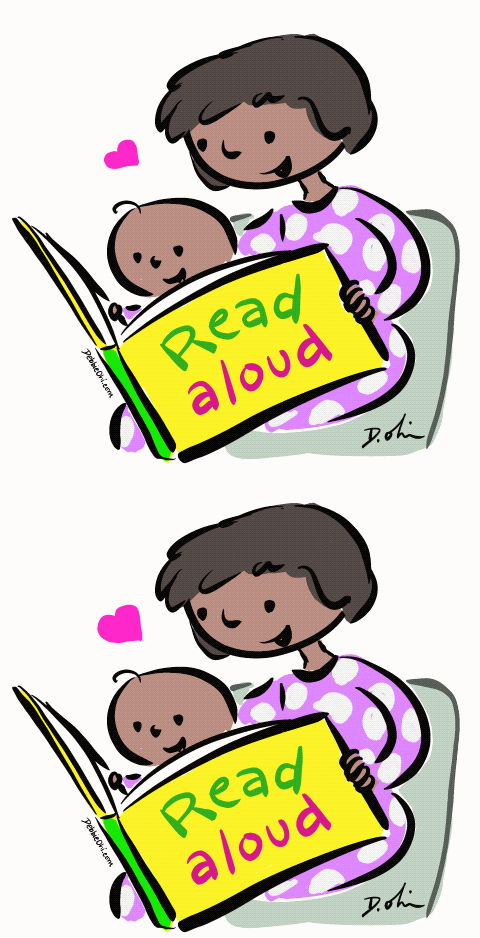 🎞️ Reading to them 🎞️ Reading to them |
|
| Singing along | |
| Pronunciation | Modelling — Speak using proper pronunciation yourself |
| Breaking difficult words down in syllables ("say ah-mae-zing, pro-ja-po-ti") | |
| 🎞️ [GIF] Animated use of mouth muscles | |
| Encouraging them to speak up | Engaging conversations (mealtimes, while cooking or freshening up) |
| Allowing them the time to response as it takes a little time to process and form responses at this stage, offer help after that, if needed | |
| Exposure to social environment with other children | Play dates (friends and family, neighbours) |
| Pre-school |
By the age of 3, if the child is exhibiting the following behavior:
- Using less than 50 words
- Not forming 3 word sentences
- Speech is not clear
- Rarely showing interest in communicating
Terrible Twos
Your child is trying out and honing their newly acquired skills. Let's not label their developmental needs as "terrible".
Every child grows in the same manner
Even if two children are getting the exact upbringing, they might turn out very differently. What works with one child may not work with another, as each child is unique.
They are too young…learning starts after school
Learning begins at birth. Children's brains start developing long before birth and continue as they start learning after birth.
They can not do anything, I should do it for them
They will learn by trying, making mistakes, failing, and trying again. You can help, guide, and cheer!
Social and Emotional Development
Some internationally recognized checklists, if you do want to check further!
⚠️ When to See a Pediatrician